
When a North Brooklyn loft owner got a $5,000 quote for basic roller shades, they jumped on Reddit to ask if it was a joke. They’re not alone. Renters and homeowners from Williamsburg, Brooklyn, to Williamsburg, Virginia keep running into sticker shock—and sunlight.
New York law makes landlords repaint every three years, but blinds aren’t on the list, so the bill lands on you. That’s why we built this straight-shooter’s guide to the best custom blinds installers in Williamsburg. We sifted through reviews, warranties, and real invoices to spotlight crews that deliver daylight control without the second-mortgage price tag.
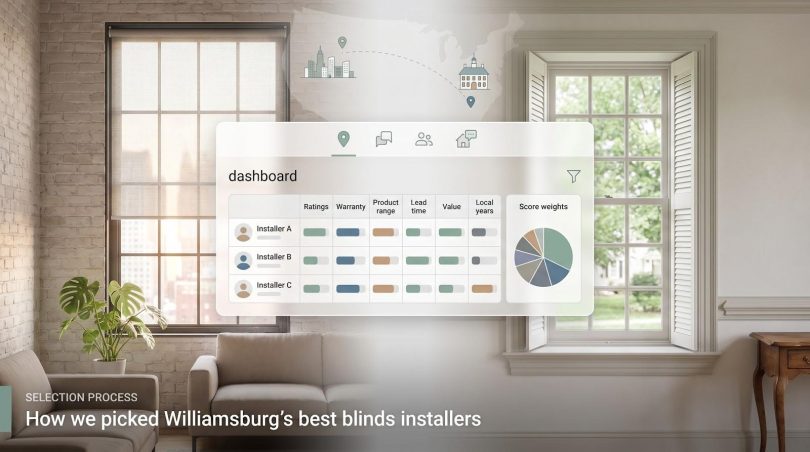
How we picked the winners
First, we cast a wide net. We scoured Google Maps, Yelp threads, neighborhood Facebook groups, and even the occasional Nextdoor rant for any company that markets custom blinds to either Williamsburg—Brooklyn or Virginia. If a name appeared more than once, we dropped it into a spreadsheet.
From there, we trimmed quickly. We cut anyone that ships DIY kits, anyone without on-site installation, and any outfit lacking a steady stream of recent reviews. Only full-service teams survived.
Next came the scorecard. We graded each contender on six concrete factors, each with its own weight:
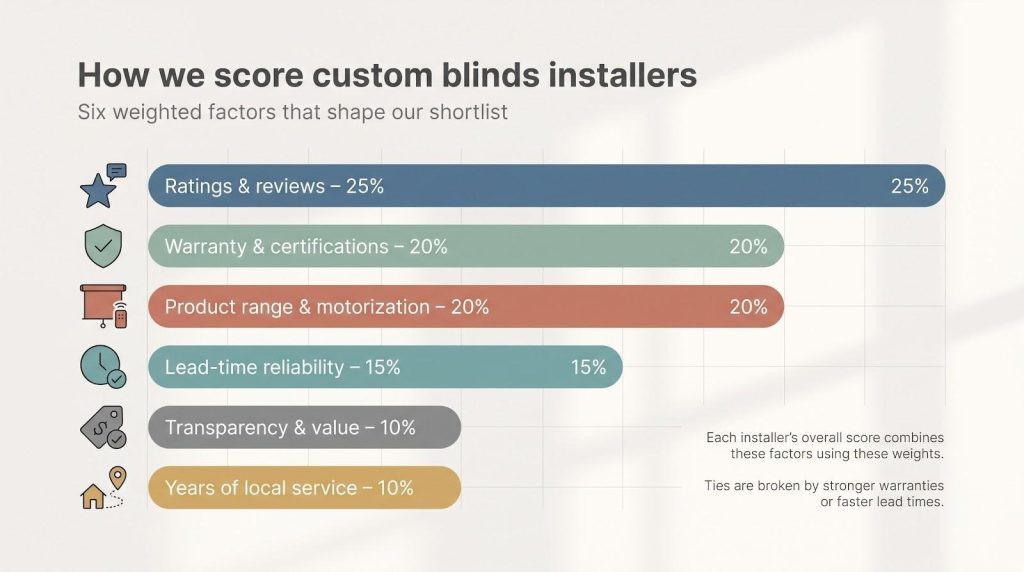
- Customer ratings and review volume (25%)
- Warranty strength and installer certifications (20%)
- Product range, especially motorization options (20%)
- Lead-time reliability from order to install (15%)
- Price transparency and overall value (10%)
- Years of continuous local service (10%)
Three staffers scored companies independently, then we averaged the numbers. Ties went to stronger warranties or faster lead times because those save headaches later.
Finally, we double-checked our picks against real quotes and service anecdotes. If a company aced the numbers but users reported ghosted follow-ups, it slid down the list or off it entirely.
The result: a short, trustworthy roster that reflects what matters most to homeowners and renters—quality, speed, and peace of mind. Up next, you’ll meet the top installers serving Williamsburg, Brooklyn.
Williamsburg, Brooklyn: our top installer
1. The Blinds Source: best overall for personal, high-quality service.
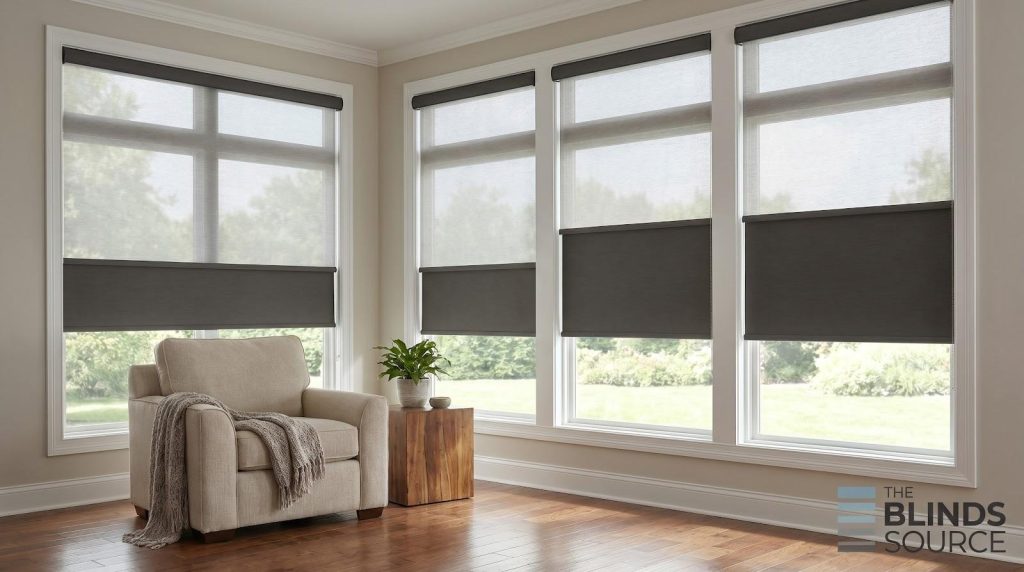
The Blinds Source Brooklyn custom blinds installer website screenshot
Walk into any North Brooklyn loft and you will likely see at least one window dressed by The Blinds Source. The family business has measured, fabricated, and installed custom treatments since 1994, and that three-decade track record shows in every detail you touch.
We like their start-to-finish approach. A design consultant visits your space, tape measure in hand, and guides you through samples that range from budget faux-wood slats to fully motorized linen drapery. If you’re puzzling over curtain-and-blind combos, their blog explains how to pair curtains and blinds with a clear list of do’s and don’ts, helping you visualize layered looks before you sign off on the final order. Because they control fabrication, those samples turn into made-to-measure blinds in about three weeks, quicker than many Manhattan showrooms that outsource production.
Quality control is tight. Every product is bench-tested before it reaches your window, and if something fails they replace it without hassle. That guarantee matters when you invest in motorized hardware. Speaking of tech, The Blinds Source speaks the same language as your smart home. Whether you want Siri to open blackout shades at 7 am or need a Lutron hub to sync with existing lights, their installers have you covered.
Pricing sits in the mid-to-premium range. Estimate about one hundred dollars for a basic faux-wood blind and five hundred or more for a motorized blackout roller. Customers consistently say the result feels worth every penny: clean lines, perfect fit, zero light gaps. If you value craftsmanship over coupons and prefer a crew that treats your apartment like their own, start here.
2. The Shade Store: most choices, smoothest showroom experience.
Step into The Shade Store’s Wythe Avenue showroom and it feels like a design magazine spread. Swatches stack floor to ceiling, staff arrive with an iPad of real-time renderings, and you begin picturing every window dressed to perfection.
Selection is the headline. The company offers roughly 1,300 fabrics and materials, from minimalist solar weaves to lush velvets. Need hardware that disappears inside millwork? They have it. Want an Alexa-ready roller shade that remembers sunrise? They have that, too.
Turnaround is faster than expected for deep customization—usually two to three weeks once your order is locked. Domestic manufacturing keeps shipping times steady. Installation is equally polished. Uniformed technicians arrive on schedule, laser-level brackets, and vacuum on the way out.
Cost reflects the premium showroom. A single fabric roller shade can exceed two hundred fifty dollars, and a patterned Roman shade often lands north of five hundred. Outfit a full brownstone and the bill can cross five figures. Still, repeat clients say the finish rivals bespoke drapery workrooms in half the time.
Choose The Shade Store if you crave showroom pampering, want to touch every fabric under warm lighting, and have room in the budget.
3. Greenpoint Blinds & Window Fashions: local value pick.
If you prefer to keep your dollars in the neighborhood without giving up quality, Greenpoint Blinds hits the sweet spot. The shop sits just north of McCarren Park, and the owner—everyone calls him Ronnie—still answers most calls himself.
Service feels old-school in the best way. Ronnie arrives with a trunk of sample books, measures twice, and suggests cost-savvy tweaks you might not have considered. One client told us he swapped a pricey hardwood blind for a textured faux-wood option that looked identical once installed and saved thirty percent.
Lead times impress. Because the company partners with Hunter Douglas and other major brands, stock fabrics ship quickly, so a two-week turnaround is common. Installation is handled by the same in-house crew year-round, which means no random subcontractors drilling into your brick walls.
Pricing lands comfortably between big-box promos and boutique markups. Vinyl minis start around eighty dollars per window, while motorized cellular shades hover in the mid-three hundreds. The bonus: if something jams six months later, Ronnie usually swings by to fix it free, no paperwork needed.
Choose Greenpoint Blinds when you want honest guidance, fair pricing, and a team that treats repeat customers like extended family.
Jumping south: why Williamsburg, VA deserves its own shortlist
Brooklyn lofts are not the only Williamsburg windows craving shade. Drive 367 miles south and you reach Virginia’s Colonial showpiece, full of sun-soaked Palladian bays and wide plantation shutters. Homeowners there face different challenges: bigger window counts, strict historic-district rules, and humid summers that demand UV-blocking fabrics.
1. Budget Blinds of Williamsburg: best warranty and one-stop convenience.
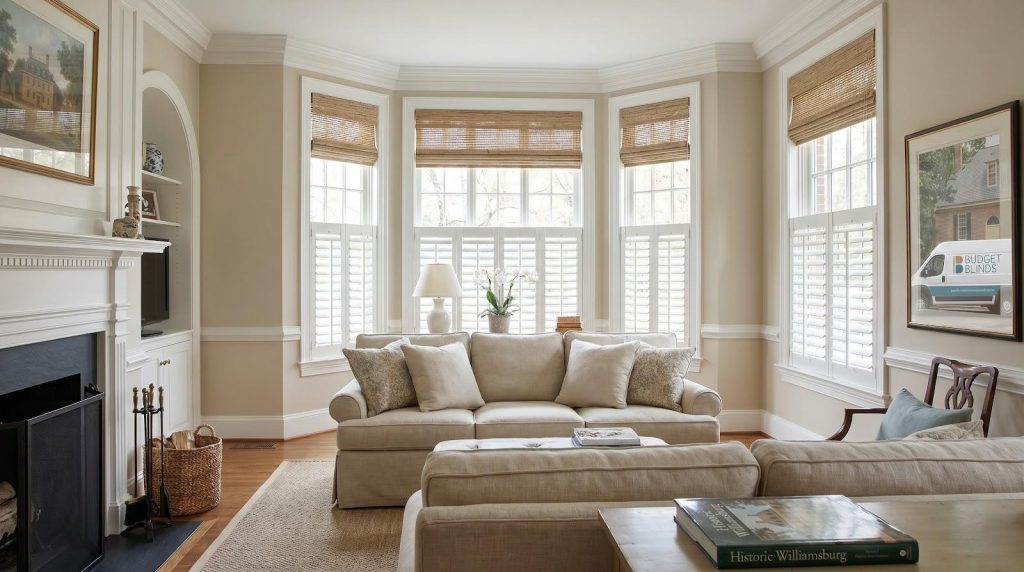
Budget Blinds of Williamsburg VA franchise website screenshot
Picture a rolling showroom in your driveway, samples on the porch, and a consultant who already knows the quirks of your 1980s colonial. Budget Blinds planted roots in Williamsburg more than thirty years ago and now fields a seasoned local crew with near-perfect online ratings.
Coverage is their calling card. They sell everything from fifty-dollar faux-wood quick ships to handcrafted hardwood shutters and Somfy-powered shades. Because they carry several manufacturers, they match most styles and price tiers without upselling features you will not use.
The clincher is a five-year, no-questions-asked warranty. Break a slat, snap a cord, or stall a motor and they replace it, no detective work required. Lead times hover around three weeks for mainstream products, and installation teams arrive in branded vans with laser levels and drop cloths. Pricing sits in the middle of the market, but the mix of broad selection, strong support, and smooth logistics makes Budget Blinds the easiest call-once option in Williamsburg.
2. Blinds & More: deep experience and personal guidance.
Blinds & More has dressed Tidewater windows since 2003, so the team has seen every curveball a Colonial remodel can throw. Their consultations feel like mini design classes: a rep explains how cellular shades trim cooling bills or how shutters can qualify for historic tax credits.
Freedom from a single manufacturer lets them cherry-pick lines from Hunter Douglas, Graber, Somfy, and niche eco brands. That range solves tricky requests, such as retrofitting motorized blackout shades into a dormer window, without forcing you into a house label.
Turnaround runs two to three weeks for stock fabrics, four to six for specialty orders. Pricing is mid-market: about sixty dollars per window for basic blinds, climbing to the high two hundreds for premium cordless cellulars. Transparent quotes and few surprise add-ons make them a reliable partner for homeowners who want seasoned advice without sales pressure.
3. Colonial Blinds & Shutters: boutique craftsmanship for historic charm.
Some Williamsburg homes date to the 1700s, and their windows have opinions. Owner-installer Parrish Martin spent two decades fitting Hunter Douglas products before opening his own shop in 2013. He still handles every measurement, order, and install.
Focus is tight: blinds, shades, and especially plantation shutters. That niche allows close attention to fit and finish. Parrish hand-levels each louver so light gaps disappear and frames sit flush against uneven plaster walls, an art in centuries-old houses where nothing is square.
Clients praise his honesty. If a mid-tier faux wood will outlast real basswood in a sun-blasted living room, he tells you, even though it lowers the ticket. Pricing stays competitive: about seventy-five dollars for quality faux-wood blinds and up to four hundred for premium hardwood shutters, installed.
Lead times average three to four weeks because Colonial orders direct from Hunter Douglas and a handful of specialty mills that move faster than large factories. If a tilt rod sticks two years later, Parrish is the one who returns to tweak it, often at no charge.
Choose Colonial Blinds when historical accuracy, owner-level craftsmanship, and straight talk matter more than showroom glamour.
Side-by-side snapshot: compare your options at a glance
We have covered plenty of detail, so here is the quick view. The table lines up pricing, speed, tech options, and overall vibe so you can spot the best fit in seconds. Circle the row that matches your priorities, then return to that installer’s profile for the full story.
| Installer | Service area | Years local | Typical starting price* | Avg. lead time | Smart-home ready | Warranty strength | Review trend |
| The Blinds Source | Brooklyn and NYC | 32 | $100 /blind | ≈3 weeks | Yes (Lutron, Somfy) | Defect-replace guarantee | ★★★★★ |
| The Shade Store | Brooklyn showroom | 80 (national) | $250 /shade | 2–3 weeks | Yes | Limited lifetime | ★★★★½ |
| Greenpoint Blinds | North Brooklyn | 10+ | $80 /blind | ≈2 weeks | Yes (Hunter Douglas) | Mfr. plus local fix | ★★★★½ |
| Budget Blinds | Williamsburg, VA | 34 | $50 /blind | 2–3 weeks | Yes | 5-year no-questions guarantee | ★★★★★ |
| Blinds & More | VA Beach and Williamsburg | 23 | $60 /blind | 2–3 weeks | Yes | Lifetime (mfr.) | ★★★★★ |
| Colonial Blinds | Williamsburg, VA | 13 (25 yrs exp.) | $75 /blind | 3–4 weeks | Yes | Lifetime (Hunter Douglas) | ★★★★★ |
*Prices reflect simplest materials; premium fabrics, shutters, or motorization cost more.
Use this table as a launch pad. If speed tops your list, Greenpoint’s quick-turn crew wins. If a strong warranty calms your nerves, Budget Blinds stands out. If you want thousands of fabrics under designer lighting, the Shade Store awaits. The next section dives into cost math, measurement tips, and smart-shade upgrades so you finish the project like a pro.
6.1 Crunch the numbers before you fall in love
A basic vinyl blind can cost twenty dollars at a big-box store, yet the average professional blind-installation bill in New York City lands around six hundred sixty-eight dollars once you tally multiple windows, removal, and labor. Projects in Williamsburg, VA trend lower thanks to cheaper labor and larger orders, but premium materials still hurt the wallet if you mis-plan.
A quick rule of thumb helps: price per window usually triples as you climb the material ladder. Think thirty dollars for vinyl minis, one hundred for faux wood, two hundred for hardwood or designer rollers, and five hundred or more once motors or specialty fabrics enter the mix. Multiply by your window count, add eight percent for hardware, labor, and tax, and you have a ballpark budget before any salesperson rings your bell.
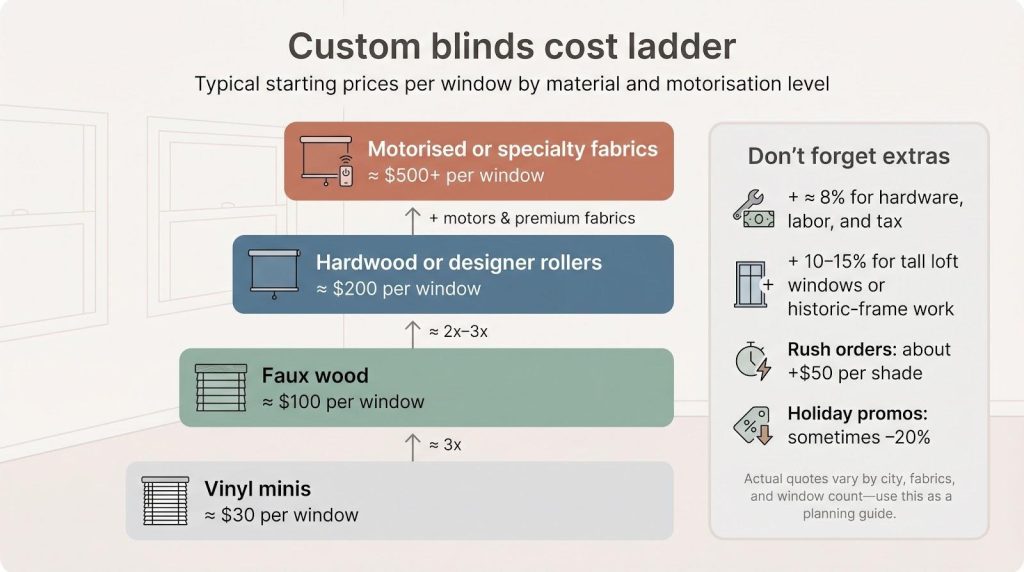
Remember the hidden extras. Tall loft windows often need oversized brackets. Historic homes may need custom frame build-outs to avoid drilling antique trim. Those tweaks add ten to fifteen percent. Ask every installer to list them up front so you can compare quotes fairly.
Finally, time is money. A rush order can add fifty dollars per shade, while holiday promos can shave twenty percent. If your move-in date allows, schedule around sales instead of paying the “I-need-these-yesterday” premium.
6.2 Measure like a pro, or let the pros do it
A change as small as one eighth of an inch decides whether your new shade slides smoothly or scrapes the frame. Old Brooklyn brick and Colonial-era woodwork rarely sit square, so assume every opening is a little irregular.
Start with width. Measure at the top, centre, and bottom, then record the narrowest number. Repeat for height—left, middle, right—and keep the longest. That ensures the blind reaches the sill without leaving a light gap.
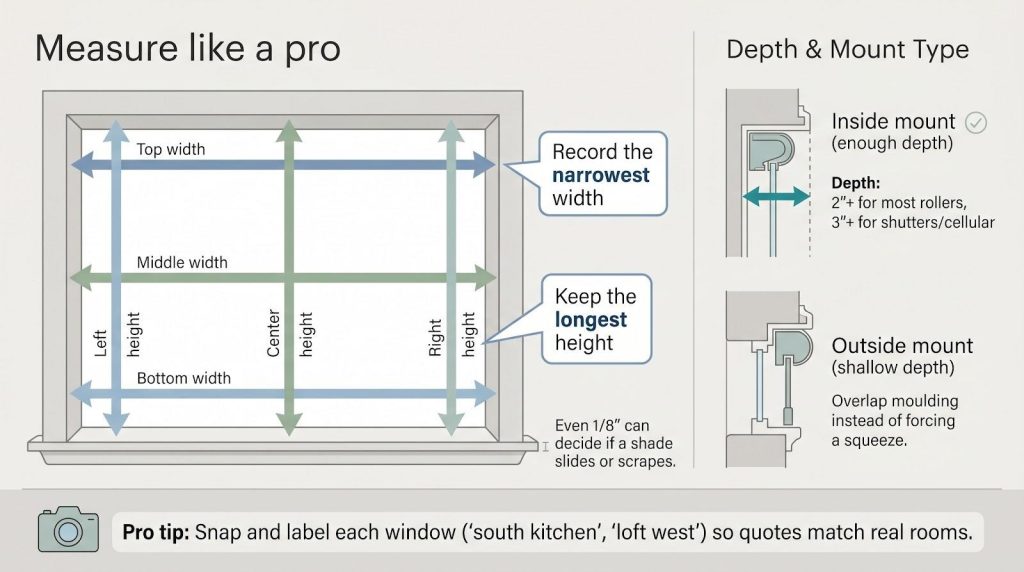
Depth matters, too. Inside-mount hardware needs just over two inches of clearance for most roller shades, while cellular or shutter frames need three or more. If your sill is shallow, plan an outside mount that overlaps the moulding instead of forcing a squeeze.
Still unsure? Book the installer’s “measure and responsibility” visit. Every company on our shortlist offers it at no cost. Once they take the numbers, any mis-fit is on them, not you, and you avoid paying for a non-returnable custom order.
Pro tip: take photos of each window and label them (“south kitchen,” “loft west”). When quotes arrive you can match line items to real rooms, avoid mix-ups, and catch odd sizes that landed on the wrong tab.
6.3 Smart shades: when convenience meets energy savings
Remote-controlled blinds once felt futuristic; today voice-activated shades are common and more reliable than ever.
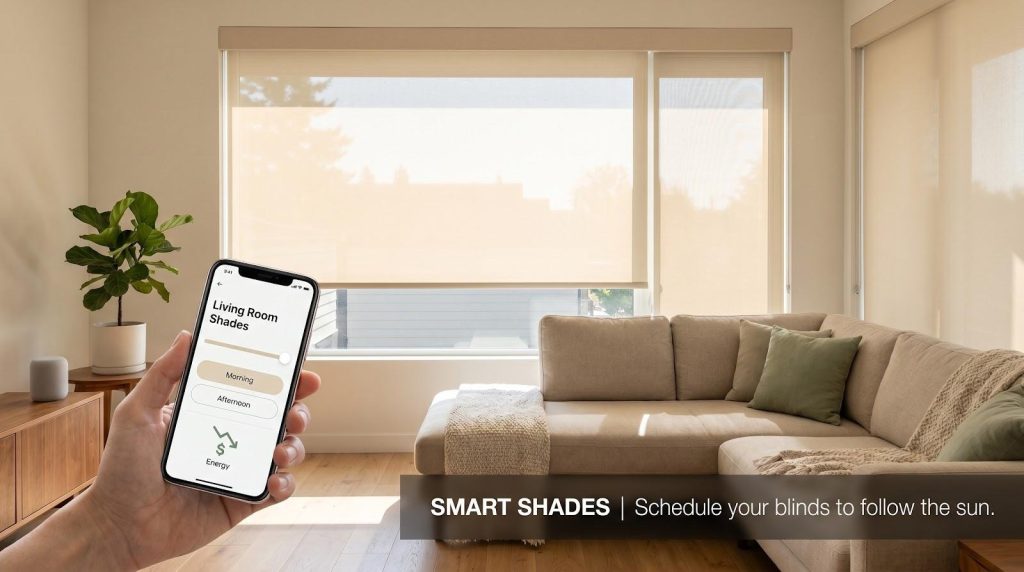
The entry tier is a battery wand tucked inside the headrail of an existing blind. For roughly one hundred fifty dollars it tilts slats with a handheld remote—perfect for hard-to-reach skylights. Step up to fully motorised rollers or cellular shades and you will spend three hundred to five hundred per window, but you gain quiet motors that lift the full shade and integrate with Alexa, Google, or HomeKit.
Why upgrade? Two reasons: comfort and lower bills. Program south-facing shades to drop during peak sun and your air-conditioning works less, cutting summer costs. Schedule blackout rollers to rise gradually at 7 am and daylight replaces an alarm buzzer.
Installation is not a casual DIY job if you want smooth smart-home integration. You will need power outlets near the window or a plan for rechargeable batteries. Every installer on our list is certified in at least one motor brand—Lutron, Somfy, or Hunter Douglas PowerView. Lean on that expertise so scenes, schedules, and voice commands sync on day one instead of after a weekend of online searches.
Tip: ask about solar trickle chargers. A slim panel on the window face keeps lithium batteries topped up, so you will not climb a ladder every six months to swap cells.
6.4 Materials and style: trends worth your money
Not all blinds wear the same outfit. In Brooklyn lofts, the current look is minimal: sand-coloured roller shades that disappear into slim cassettes, letting brick walls do the talking. In Virginia’s Colonials, crisp white plantation shutters remain popular, framing mullioned panes like pages from a history book.
Sustainability is no longer fringe. Bamboo and woven-grass shades add warm texture and score eco points because the plants regrow quickly. Recycled-fabric rollers are gaining attention, filtering glare without the micro-plastic guilt.
Layering is the insider move. Mount a blackout roller inside the jamb for sleep, then hang sheer linen drapery outside the frame for softness. You control function and aesthetics independently, and the combo makes windows appear larger.
Colours lean earthy: mushroom, sage, and charcoal are edging out stark white. If resale value worries you, keep the blind neutral and bring colour into drapery that can change later.
One warning: glossy PVC slats glare under afternoon sun and off-gas in summer heat. Spend the extra twenty percent on faux wood or aluminium; your eyes and lungs will appreciate it.
6.5 Tenant vs. landlord: who pays for the blinds
If you rent in New York City, expect bare windows. The Housing Maintenance Code requires landlords to supply heat, hot water, and a fresh paint job every three years, but blinds are not on the list. As Brick Underground puts it, “Don’t count on finding those.”
That leaves the decision and the cost to you. You can ask your landlord to reimburse inexpensive vinyl blinds, yet custom work is almost always a tenant expense. Keep receipts; if your lease labels window treatments a “fixture,” you may need to leave them behind at move-out.
Virginia landlords follow similar practice. Basic mini-blinds sometimes appear in mid-tier rentals, but no state rule forces owners to provide them. Before you splurge, email the property manager. A brief notice protects your deposit and confirms whether you must restore original coverings when you leave.
Landlords, this cuts both ways. Install durable, cordless faux-wood blinds and you discourage tenants from drilling extra holes or hanging sheets. The small investment protects trim and improves curb appeal. Choose child-safe styles to reduce liability.
Bottom line: ask early, get the agreement in writing, and budget as if you will pay for the blinds yourself. Anything the landlord covers is a bonus.
Next steps: get those windows dressed
You now have a game plan. Start by writing two lists: needs (blackout in the bedroom, motorisation for tall clerestory windows) and nice-to-haves (designer fabric, hidden hardware). Clear priorities help each quote stay on target.
Choose one installer from your city’s top three, plus a backup for comparison, and book free measurements. Bring your budget notes, photos, and any landlord rules to that visit. Let the rep confirm sizes, suggest material tweaks, and give a written quote. Two visits take an afternoon and can save hundreds by revealing upsells or omissions.
While the pros handle fabrication, prepare your space: move furniture, patch old drill holes, and check outlet access if you picked motorised shades. A tidy area speeds up installation day.
Afterward, file warranties and save installer contacts in your phone. If a lift cord snaps next year or you decide to add smart-home scenes, help is a quick text away.
Great window treatments do more than block glare; they improve comfort, cut energy use, and may even raise resale value. With the groundwork finished and the right team in place, you will enjoy sunlight on your terms. Here’s to living brighter and sleeping darker, exactly when you choose.