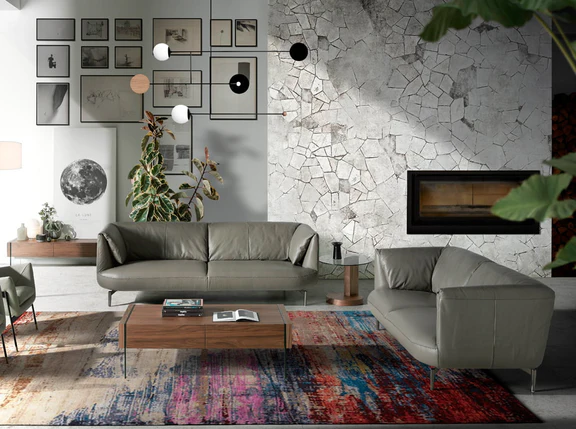

The photograph is always better than the piece and this only becomes clear after the delivery.
This is the first thing anyone who has bought modern online furniture learns. The sofa looks perfect on the website. Deep charcoal leather, sharp profile, sitting in what looks like a Milan apartment with tall windows and polished concrete floors. You click through. You swipe. You read the specifications. You add to the cart.
Twelve weeks later, something other than the photographed piece arrives.
The color is a shade off. The leather feels thinner than you expected. The foam in the cushion gives faster than the listing suggested. You sit on it, and something about the proportion feels wrong. Maybe the seat depth. Maybe the back angle. You cannot quite name it, but the piece does not feel the way you imagined it would. That is the quiet problem with modern online furniture.
No screen shows you how a sofa feels when you actually sit on it. No camera angle tells you whether the leather is full-grain or corrected. No product page reveals how the frame is joined under the upholstery.
You are buying on faith. And faith is expensive when a section costs three thousand euros.
What the product page leaves out
What the online listing usually hides:
- The difference between full-grain, top-grain, and bonded leather. All three can be photographed to look identical. Only one ages well.
- The frame material. Kiln-dried hardwood versus engineered board is a decade-long difference in how the piece holds up.
- The cushion construction. High-resilience foam wrapped in fiber feels completely different from standard foam, but they look the same in a render.
- The hardware. Whether made of metal or plastic cores determines whether the drawer tracks function properly by year five.
- The finish in humid conditions. A flawless lacquer in Barcelona may become cloudy and brittle after only two seasons in Accra.
None of this appears in product photography. None of it appears in written specifications unless the brand chooses to be transparent, which most are not.
The freight problem nobody warns you about
There is also the freight problem.
Anyone who has shipped furniture to Ghana knows the story. The piece ships from Europe. It sits in a port. It sits in another port. It clears customs, sometimes. It arrives with a scuff on one corner that was definitely not there when it left the factory. You file a claim. The email chain goes dormant. Someone suggests the damage happened in local handling, not international shipping. You accept the piece because the alternative is waiting another sixteen weeks.
So what does modern online furniture actually cost you?
The list price. Plus the freight. Plus the customs. Plus, the margin on damage you absorb because fighting it takes more time than it is worth. Plus, the piece itself sometimes does not match what you saw.
A different way to buy the same product
Dellino takes a different approach, and it is worth thinking through why.
The showroom in Accra carries more than ten European manufacturers, with Angel Cerda sitting at the center of the furniture range. Sofas, armchairs, dining pieces, office furniture, bedroom sets, shelving, and TV units.
The brand ships with ISO 9001 certification and a full manufacturer’s warranty.
Same Spanish product you would find on a Barcelona design house’s website. Same catalog. Same build. Different buying experience.
You enter. You take your seat on the sofa. You stroke the leather material. You notice the walnut finish under real Accra sunlight instead of artificial photographs. In case the seating depth is not satisfactory for you, you can choose another setup. In case the tone looks too cold, you select a new one.
You leave having specified a piece you have actually experienced.
Service that sits in the same city as you
There is a second benefit that matters just as much. Service.
If something goes wrong in year two, the warranty claim does not start with an email to Spain. It starts with a phone call to Accra. The team that sold you the piece handles it. The manufacturer relationship sits locally.
Why anonymous pieces age badly
Perhaps the strongest argument against modern online furniture for Ghanaian buyers is simpler than all this. The pieces you buy online are anonymous. They ship. They arrive. They sit in your house. If something is wrong, you are negotiating with a customer service desk on another continent, through a time zone gap, in a language that may not be yours.
The pieces you buy through a proper showroom have a history. Someone knows where they came from. Someone signed for them. Someone remembers the spec you chose.
That is the old-fashioned version of what online furniture platforms try to replicate with chat widgets and tracking links.
It works better in person.
What the numbers actually look like
Angel Cerda prices at Dellino run from around EUR 500 for accent pieces to above EUR 4,000 for larger configurations. Price points sit in the same band as European online retailers, without the freight, customs, and damage risk sitting on top.
The modern online furniture model works when you are buying a lamp. It stops working when you are buying a sofa that is supposed to last fifteen years.
Book a visit to the Dellino showroom in Accra when you want to see the Angel Cerda collection in person.