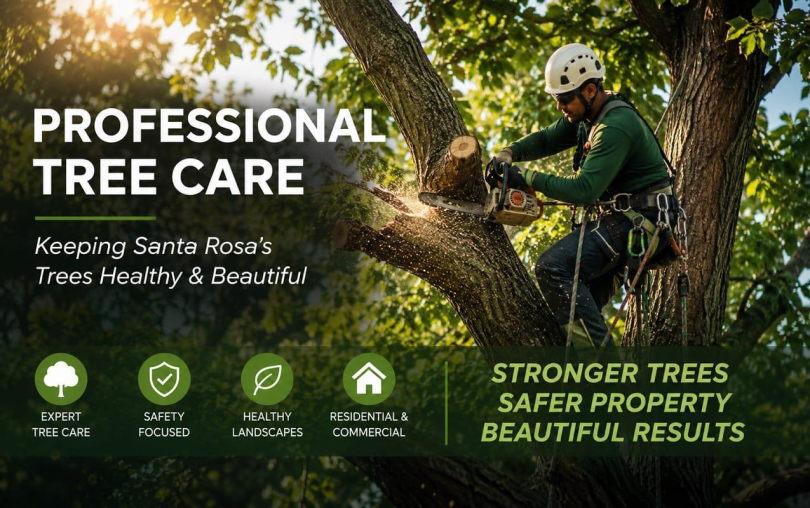

Healthy trees add shade, privacy, beauty, and value to homes throughout Santa Rosa. Choosing tree service in Santa Rosa helps property owners maintain mature oaks, redwoods, maples, fruit trees, and ornamental plantings while protecting buildings, driveways, walkways, and outdoor living areas. Professional care is especially important when trees grow close to structures or show signs of disease, decay, storm damage, or unstable branches.
Santa Rosa properties often include large trees shaped by seasonal rain, summer heat, strong winds, and dry conditions. These environmental changes can expose weak limbs, damaged roots, and structural defects that are difficult for an untrained person to recognize. A qualified tree care team can inspect each tree, explain the available options, and recommend practical work based on safety, appearance, species, and long-term health.
Complete Residential Tree Care
Residential tree care should be planned around the condition and purpose of each tree rather than a one-size-fits-all schedule. Some trees need light crown cleaning, while others may require structural pruning, deadwood removal, cabling, clearance work, or complete removal. An experienced crew can work carefully around roofs, fences, gardens, pools, vehicles, and neighboring properties.
A professional assessment also helps homeowners avoid unnecessary cutting. Excessive pruning can weaken a tree, encourage unwanted growth, and create larger wounds that invite insects or disease. Properly performed work removes hazardous or competing branches while preserving the tree’s natural form and supporting healthy development through future seasons.
Expert Tree Trimming and Pruning
Tree trimming improves clearance, appearance, and safety, but effective pruning requires an understanding of branch attachment, growth patterns, and species-specific behavior. Removing dead, cracked, rubbing, or poorly positioned limbs can reduce hazards and improve airflow through the canopy. Branches may also be selectively shortened away from roofs, chimneys, windows, sidewalks, and utility corridors.
Timing matters as well. Pruning during unsuitable conditions may increase stress or spread certain tree problems, while carefully planned maintenance can encourage stronger structure and healthier growth. A professional crew uses appropriate equipment, makes clean cuts, and avoids harmful practices such as topping, flush cutting, or leaving large broken stubs.
Safe Tree Removal Planning
Tree removal is sometimes necessary when a tree is dead, severely damaged, diseased, unstable, or positioned where it creates an unavoidable risk. Removing a mature tree is complex because its weight, height, lean, root plate, and surrounding obstacles must all be considered before work begins. Professional removal planning reduces the possibility of damage to structures, landscaping, irrigation systems, and nearby trees.
Santa Rosa regulates the removal and alteration of certain trees, so property owners should confirm current requirements before authorizing work. Protected or heritage trees, street trees, trees near scenic roads, and trees associated with development may require additional review or permits. A knowledgeable tree company can identify potential concerns and help the owner understand what should be checked with the appropriate city department.
Emergency Response After Storms
Heavy rain and wind can turn previously unnoticed defects into immediate dangers. Fallen trees may block driveways, damage roofs, pull down fences, or interfere with access to a property, while broken limbs can remain suspended above homes and pedestrian areas. Emergency tree work should begin with keeping people away from the hazard and treating downed electrical lines as live.
A responsive crew can stabilize the area, remove dangerous sections, clear access routes, and coordinate the next stage of cleanup. Emergency work is not simply ordinary removal performed faster; it requires careful assessment of tensioned limbs, split trunks, unstable roots, and hidden structural damage. Once the urgent hazard is controlled, a follow-up inspection can identify remaining risks and recommend corrective pruning or removal.
Keeping Trees Away from Power Lines
Branches growing toward electrical conductors require special caution because ordinary ladders, saws, and homeowner tools may create life-threatening conditions. Trees near service drops, utility poles, and distribution lines should be assessed before any cutting begins. Property owners should never attempt to handle a tree that has contacted a power line or is leaning toward electrical equipment.
Professional line-clearance work focuses on creating safe separation while protecting the tree from excessive or poorly placed cuts. Depending on the situation, coordination with the utility provider may be required before a crew can proceed. Clear communication, appropriate equipment, and safe work boundaries help protect residents, workers, utility infrastructure, and the tree itself.
Stump Grinding and Yard Restoration
Removing the trunk does not always remove the problem. Remaining stumps can interfere with mowing, attract insects, create trip hazards, occupy planting space, and produce unwanted regrowth. Stump grinding reduces the visible stump below grade, allowing homeowners to restore the area with soil, grass, mulch, hardscape, or new landscape plants.
Root systems may extend beyond the immediate stump, especially in older trees, so the finished area should be evaluated before installing foundations, paving, irrigation, or replacement trees. A professional cleanup can include removing chips, raking disturbed soil, and leaving the site ready for the next landscaping step. The best restoration plan depends on stump size, access, soil condition, and the intended use of the space.
Tree Health and Disease Detection
Early inspection can reveal problems before they become expensive emergencies. Warning signs include thinning foliage, discolored leaves, cavities, fungal growth, peeling bark, dead branch tips, soil movement, exposed roots, and cracks around branch unions. These symptoms do not always identify one specific cause, which is why diagnosis should consider the tree species, site conditions, irrigation, drainage, pests, and recent weather.
Good tree care may involve correcting watering practices, improving soil conditions, reducing competing branches, treating a pest issue, or removing only severely affected portions. In some cases, preservation is realistic; in others, removal may be the safest option. Clear explanations help property owners make informed decisions instead of reacting to symptoms with unnecessary cutting.
Commercial and Property Management Services
Commercial landscapes, rental communities, vineyards, offices, and multi-building properties need consistent tree maintenance to protect people and reduce disruption. Overgrown branches can obstruct signs, lighting, parking areas, sidewalks, entrances, and security cameras. Scheduled inspections allow managers to address developing hazards before they lead to complaints, access problems, or costly property damage.
A dependable maintenance plan can combine seasonal pruning, tree removal, stump grinding, emergency response, and documentation of completed work. Crews should understand site access requirements, pedestrian control, tenant communication, and cleanup expectations. For property managers, organized scheduling and transparent estimates make it easier to maintain attractive grounds while controlling operational costs.
Choosing the Right Tree Company
Before hiring a tree company, homeowners should ask about licensing, insurance, worker safety practices, equipment, cleanup, and experience with local trees. A written estimate should explain the recommended service, the scope of cutting or removal, stump treatment, debris handling, access requirements, and any exclusions. Extremely low bids may omit important safety measures or leave disposal and restoration costs unclear.
Look for a company that communicates clearly and evaluates the entire situation before starting. The best provider will explain whether pruning, support, monitoring, or removal is the most suitable approach rather than automatically recommending the most expensive service. Local knowledge is valuable because Santa Rosa properties vary widely, from compact residential lots to expansive rural and Wine Country landscapes.
Maintaining Safer, Healthier Landscapes
Consistent maintenance is usually more effective than waiting until a tree becomes an emergency. A seasonal inspection can identify branches that need attention, changes in soil moisture, signs of disease, and growth that is approaching structures or utility lines. Scheduling smaller corrective tasks early may help preserve valuable trees and reduce the complexity of future work.
When you need tree service in Santa Rosa, choose a team prepared to combine safety, horticultural knowledge, careful workmanship, and responsible cleanup. A thorough evaluation creates a clear path forward, whether the goal is preserving a heritage tree, opening a view, removing a hazardous trunk, or restoring a damaged yard. With professional support, Santa Rosa property owners can enjoy attractive, functional landscapes with fewer unexpected tree-related problems.